Thursday, October 15, 2015

Yuma Territorial Prison


Yuma Territorial Prison, Yuma, Arizona  


One hot day in September, we visited the Yuma Territorial Prison and Museum.

The prison was established in 1875 and I could only imagine the deplorable conditions the prisoners endured for their crimes. 


But even though the conditions were terrible, some did not learn their lesson and were repeat visitors. 


The cells were extremely small and four to six  inmates to a cell. No bathrooms, only a pot. 


Here is a link to a very interesting clip narrated by the curator of the prison, Tina Clark.  We met her and she has a wealth of interesting stories to tell.


Another clip that is interesting.

https://youtu.be/6pS7BloOA1U

On the second link, you have to highlight the link and select the go to option.  Don't know why it did not link as the first link.

Monday, September 14, 2015

Expensive Desert Dirt


What do you think of when you think of Arizona? Do images of cactus, sandstorms, perhaps a cowboy riding off into the horizon with that sandstorm blowing against his back, and miles and miles of brown dirt? That is the visions that are conjured up in my mind. 


But did you know, that brown dirt is expensive??!

As we drive from the military post toward Yuma, we see fields of that brown dirt being irrigated, preparing for the winter growing season.  In the Yuma Valley, acreage ranges from $23,000  - $26,000 per acre.


Why so much?   Well...

 I was surprised to learn that Yuma County produces 90% of packaged lettuce that the nation consumes. It is grown from November to March. Yuma County is the nation's third largest vegetable producer.  There are 175 different crops and seeds grown or produced in the area to include Cauliflower, broccoli, spinach and other vegetables.


"Orchards and vast melon patches stretch across the landscape. Not only is Yuma County Arizona’s top producer of lemons, tangelos and tangerines, it is also tops for watermelon and cantaloupe cultivation". 


Rain is scarce in this region in fact, less than three inches annually.  

The brown dirt was fertile  "but water was the missing component, though the mighty Colorado flowed nearby. The Bureau of Reclamation's first big water project in the West gave nature a hand, with construction of the first dam on the Colorado and completion of the Yuma Siphon - delivering water through a huge tunnel built under the riverbed - in 1912, the same year Arizona became a state". 


"There also are more than 40,000 acres of wheat grown in this region. Desert durum comprises about 95 percent of Arizona's wheat crop, with two-thirds of that exported -- mainly to Italy for use in making premium pasta. 

Yuma growers also grow kosher wheat used by Orthodox Jews to bake matzo (or matzoh), the unleavened bread wafers that are eaten at Passover. Because the rules for kosher production include that the wheat not receive moisture immediately prior to harvest, Yuma's desert conditions and controlled irrigation make it a perfect spot to grow this specialty crop.

Dates are another local crop with Biblical roots. Date production in the Yuma area is now total about 10 million pounds a year, a $30 to $35 million dollar industry that employs more than 2,000 people annually". 


Knowing nothing about dates, I was surprised to learn that there is a male and a female Date Palm.  But, birds nor bees are attracted to the female flower, so they are hand pollinated. Only the female tree produces fruit.  The "Medjool" dates are the most expensive because they are large, soft and very sweet.

"Medjool" dates In their native land used to be reserved for royalty. A small number of "Medjool" offsets came to the United States in 1927 from Morocco. These few plants gave rise to the current "Medjool" date industry of California's Bard Valley and adjacent Yuma, Arizona, that produces about 30 million pounds of date annually with an approximate value of $40 million. 

I haven't tasted a date milkshake yet but I know I will. Also, I'm hoping to take a tour of a date farm....


Please note that I used some pics and info from various internet web sites such as visityuma.com. 

Friday, August 28, 2015

Petrified Forest National Park

While parked  at Fort Tuthill in Flagstaff, we made a day trip to the Petrified Forest.  Glenn had always wanted to visit.  We had a great day.

A short distance out of Flagstaff, we also wanted to visit Walnut Canyon National Monument.  What a neat surprise.  This place has cliff dwelling ruins very visible from the visitors center.  The also have hiking trails in the canyon.  We weren't prepared to walk a long distance but we did venture down the trail a little ways.  I took a few pictures of the ruins and canyon. 


At viewing this ancient Indian dwelling, I saw a cat like animal (we decided it was a mountain lion) meander into the middle opening.  Shortly after the mountain lion went in, I saw a smaller round furry animal come out of the dwelling. I guess he decided the mountain lion could have the whole space.  Lol. 

I told the rangers what I saw.  They were excited and set up a video camera to catch a video of the inhabitants.  Glenn had the camera but not the long lens, so no picture, but it was rather exciting.  

After that short visit, we traveled a little bit on old Route 66.  


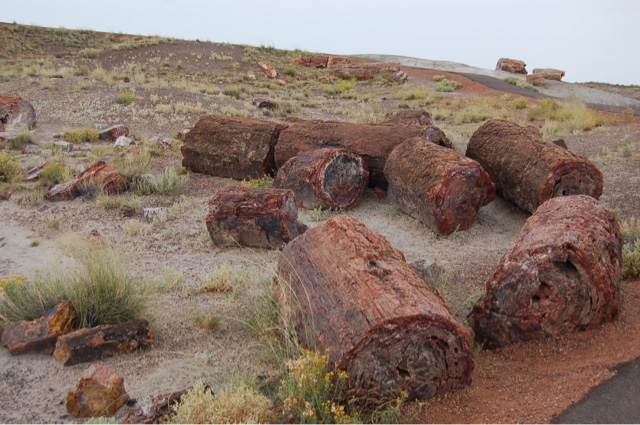
We arrived at the Petrified Forest right before it started to rain. But, the rain just made the petrified wood glisten and the colors pop.


You are allowed to walk along the trails, but don't you dare pick up any fragments.  In fact, at the entrance gate, you are asked if you have any rocks.  We did have a rock Glenn found in a RV parking lot that looked interesting.  The ranger couldn't decide if it was petrified wood or not, so we had to check at the visitor/museum for clarification.  It wasn't.....they didn't think.

The rangers likes it when it rains because it washes more of the buried trees and fossils.  For the most part, the trees are left where there become exposed. 


Agate Bridge. In 1911, people would stand on the log.  It was supported in long time pass, 
but today it would just be left to erode over time. 


   Tepees


At the end of the road, an old Studebaker guards Route 66 in remembrance of days gone by. 

It was getting dark by the time we started back to Flagstaff, but Glenn made a short detour to view the famous "Standing on the corner in Winslow, Arizona".  Made famous by the old Eagles song,
 "Take It Easy"